

Rightness is a prison
And the judo of agreeing

I recently did a “50 things I know” post, and asked which ones people wanted to hear more about. This was number 22 on that list.
We just wrapped up our first quarterly reviews for Astera’s spring residency cohort, and one of my favorite things to come out of it was this statement by resident Edwin Kite: “Based on past completed projects of comparable ambition, it is near certain that our initial scientific assumptions are wrong.”
This is the reality of science. It’s also the reality of life more generally. It’s actually really, really hard to be right about all but the most basic things. Sometimes we start with the right facts and assumptions, but draw the wrong conclusion. Sometimes we stumble across a correct conclusion, but for all the wrong reasons. More often we’re inept carpenters, trying to build with the wrong tools, perched atop a crumbling scaffold. It’s a wonder we’re able to build anything at all that lasts.
I, for one, am wrong constantly. I’ve been wrong about big things, like thinking the point of life is to accrue money and status and the kind of furniture that has a name. Like thinking I don’t need to smile at people, or give them affirmation, in order to make them feel safe around me. Like thinking that there are no biological differences between men and women that might be relevant to skill in poker.
I’ve been wrong about smaller things, like — just today — the cost of a replication experiment someone wanted to run, whether to use the express line at the grocery store, the prospect that a candidate was ghosting me, whether to binge on Mexican food and TNG instead of working on my book manuscript (no regrets), and whether I’d feel perfectly comfortable if I showed up to the office in leggings (regrets).
Given that perpetual wrongness is the natural condition of human beings, it’s funny that we try so hard to avoid acknowledging that we’re wrong, either to others or to ourselves.
Trying to avoid being wrong would look completely different. It would look like cultivating the mental habits Philip Tetlock identified in Superforecasting as central to great forecasters’ ability to predict the future with far greater accuracy than normal folk. People who are good at forecasting update their views frequently, actively seek disconfirming evidence, and try to take the outside view. They try to break their big beliefs down into more granular ones, to expose more surface area to contact with the real world. (For real-life examples of these habits in action, see Matt Yglesias, Scott Alexander, Alexey Guzey, GiveWell, and, just yesterday, Kelsey Piper.)
None of these things are very hard to do; they’re certainly within the capacity of most medium-smart people. So what stops most of us from seeing the world more clearly? Mere speculation on my part, but I think most of this is downstream of one core superpower of superforecasters: They’re not strongly psychologically committed to being right about any particular fact or in any particular instance.
This is one of life’s delicious ironies: The way to be right more often is to care less about being wrong.
This matters a lot, even if you don’t aspire to be a superforecaster. You may not need to be able to predict commodity prices, or guess how the solar build-out in China is going to go. But choices that really do matter to us are often circumscribed by a need to defend our past decisions. We might stay in a bad relationship we know we need to leave, cling to a house that’s a bad investment, or hold onto an ideology that doesn't fit the facts, all because we confuse changing our minds with losing our dignity.
When you learn to admit that you’re wrong, you also learn to course-correct much faster. You’re not committed to the decisions of the you who existed yesterday, who had much less information than the you of today.
Only one little problem: Being wrong hurts.
Or does it?
Rightness is a prison
There are some kinds of deep wrongness that are so bound up with our identities that addressing them might actually require some spiritual and social excavation. Let’s leave the advanced stuff for the advanced course, and start with run-of-the-mill wrongness, you-had-bad-facts-on-the-internet wrongness.
I think it’s actually a mistake, or even a delusion, to think that this kind of wrongness hurts — and that it’s possible to experience it in a completely different way. I think this because I’ve experienced firsthand the feeling of the delusion being broken.
For most of my life, until well into my 30s, I was totally under the thrall of seeming-rightness. I put an astonishing amount of energy into keeping up a pretense, internally and externally, that I was always right. I can’t for the life of me remember why I felt this way — probably because I didn’t have reasons for it, per se — but I remember feeling existentially threatened by the possibility that I might be wrong or just not know something. I got so good at coming up with plausible arguments for my beliefs that I often didn’t even realize I was full of shit.
The full story of how this changed will have to be an IOU for the book, but the short version is that I fell in with some rationalists and got convinced that I should be more dedicated to following and acknowledging the truth, and upon doing it came to realize that the pain that threatened to overwhelm me was just an illusion, a trick of the ego.
What actually hurt was the feeling of resistance to being wrong, the cognitive dissonance between who I was at my outermost and innermost layers — a feeling that would build and build for as long as the dissonance was maintained.
Being wrong, and saying so, is by contrast liberating — like your mind is tangled up in a very complicated knot of stories and anxieties, but by pulling out just the right thread, the whole thing falls apart. Acknowledging what is true is so much cleaner, psychologically, than maintaining everything necessary to avoid acknowledging it. Feynman famously said, “you must not fool yourself, and you are the easiest person to fool,” but I think I disagree. Fooling yourself takes work.
The judo of agreeing
Maybe you object that it’s not self-punishment that makes admitting you’re wrong so painful, but the ridicule of others. I’m sympathetic, but think this fear is also misplaced.
We tend to feel vulnerable when we admit that we’re wrong — we feel weak and undefended, and we assume that others will see us this way too. But, in fact, admitting fault typically has the exact opposite effect. Acknowledging that you’re wrong displays a willingness to be vulnerable that we intuitively understand only the confident can afford.
My husband calls this the “judo of agreeing.” Just like a skilled judo player uses an opponent’s momentum to throw them, a well-timed admission of fallibility shows a disarming level of self-confidence that, paradoxically, throws off those who are tempted to attack us.
This is a great example of the paradoxical nature of many agency-increasing moves: Social acts that seem weak from the inside, when undertaken without defensiveness, actually read as very strong. For this to work, however, the “without defensiveness” part is really important: You don’t earn any status points when litigating technicalities.
“I was wrong about hiring a crooked contractor, but his website looked really nice, and I wanted to get us a good deal, and you kept pushing me to hire somebody!” This is clearly an attempt to soothe the feeling of being wrong, rather than reckoning with the fact that you were. The high-status move is instead to simply acknowledge the error and keep moving.
Admitting that you’re wrong about something during a contentious discussion is also a quick way to show that you’re an honest dealer in the truth, not just a person hell-bent on winning. This can instantly make people trust you more and interrupt the mutual cycle of defensiveness that gridlocks so many heated debates. You immediately have the “mortal enemy” label removed and replaced with a “friend?” tag; people’s tone shifts instantly. Research shows that people who admit wrongness in online interactions are viewed as more likable and competent, and people are more willing to interact with them in future scenarios.
It’s okay to start small
You might want to get some practice with admitting wrongness before plunging into it in high-stakes situations. A great way is to start practicing with family and friends.
If you reflect for even an instant, you should be able to remember one time that you were wrong about something in one of your immediate relationships. Perhaps you gave a friend a piece of advice that wasn’t so sensible, or boldly aired a prediction about the world that turned out to be incorrect. Try this: send them a text or a voice memo, saying, “I’m practicing being wrong. I’d like to admit that I was wrong about [x]. Thank you for listening.”
Beginning with small things is fine. You can admit that you were wrong about which New York pizza is the best, or about the best route for driving to you and your partner’s favorite restaurant. If the admission is uncomfortable, even a tiny bit, you’re making progress.
But you do want this process of training to lead before long to making larger admissions, to yourself or others. The irony is that we have a tendency to put the least effort into questioning our most consequential beliefs — like what our priorities are — even though, logically, we should spend the most time trying to disconfirm them. The more you practice, the quicker you’ll develop the facility of holding your opinions lightly, and eventually you’ll do it by default. This sounds like a small thing, but it’s a genuine transformation.
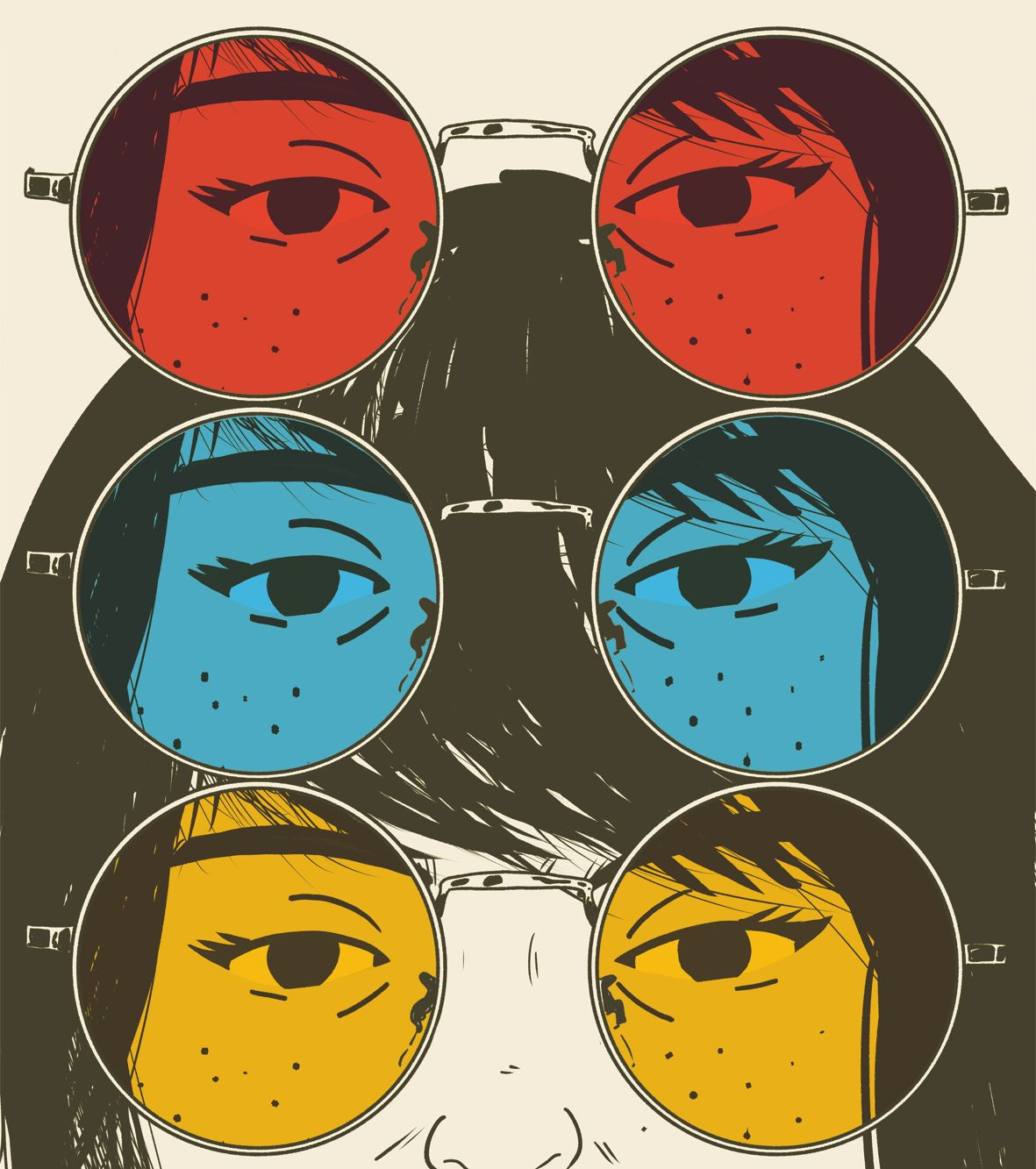
To the dogmatic person, beliefs function like blinders, narrowing your field of vision so you can only see what confirms them. They feel like rigid frames bolted to your vision, or armor defending you from attack. But once you get used to loosening your grip, the same beliefs can transform into lenses you can slip on and off, experimenting with how the world looks in each tint. You can try on these rose-colored glasses, then these darkly tinted ones, noticing how each alters your perception, without mistaking any single view for the whole of reality. What began as constraint becomes play, and that play is the beginning of real freedom.
2026 Update: I wrote a book, You Can Just Do Things, that’s a practical guide to developing personal agency from someone who learned it later in life. It’s now available for purchase.
I didn’t think I wanted to read this through because it would make me feel wrong about something, but I was wrong, and that’s alright.
My marriage advice: you can choose to be happy or be right